






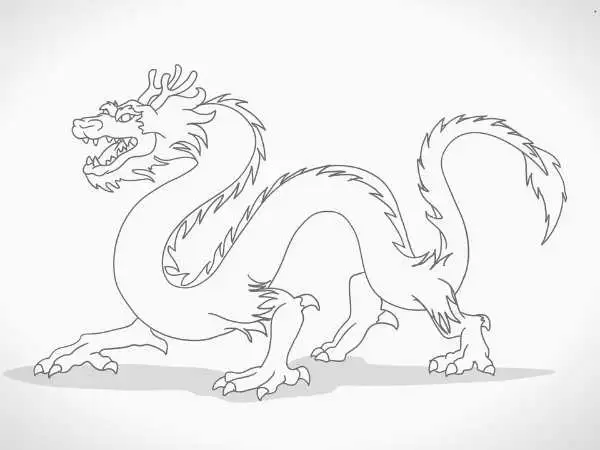


Here’s the full slow-and-steady breakdown. I’ll add small details under each step so you don’t feel stuck.
Step 1: Start With Rough Shapes to Build the Dragon’s Body
Before you worry about fancy details or fire-breathing jaws, sketch in basic circles and ovals.
- A circle for the head
- A bigger oval for the chest
- A long stretched shape for the tail
- Add a line to mark the spine
This is your skeleton. Don’t try to make it perfect. Think of it like placing building blocks — it just needs to feel balanced, nothing fancy.
Step 2: Add the Neck, Spine Flow, and Tail Curve
Dragons always look cooler when their bodies have flow.
Use long soft lines to connect the head to the torso. Then extend that line into a tail that bends naturally — S-curves are great.
You’re basically adding motion before adding details.
also read : – Deleting Apps On IPhone
Step 3: Sketch the Legs and Claws for Structure
Now add the limbs. Dragons normally have strong hind legs and lighter front legs.
Use simple shapes:
- cylinders
- triangles for claws
- rounded joints
Don’t stress about anatomy. Think: “Would this hold the dragon’s weight?” If yes, you’re good.
Step 4: Outline the Wings With Big, Loose Strokes
Wings are where people panic, but don’t. Think of a bat wing:
- long arm bone
- long fingers
- a stretched membrane
Sketch triangle-like shapes that feel dramatic. Dragons love drama.
Step 5: Shape the Head, Jawline, and Facial Structure
Now we zoom in. This part is fun.
Give your dragon:
- a pointed or rounded snout
- eyebrow ridges
- big or narrow jaws
- nostrils
- horns if you want (horns always look cool)
Play with shapes. Some dragons look soft and dog-like, others look like they eat mountains for breakfast.
Step 6: Add the Eyes and Expression
This can change the whole mood.
- A slit eye = dangerous
- A rounded eye = friendly
- A low brow = angry
- A raised brow = curious
Even a tiny line can shift the vibe. Dragons have range!
Step 7: Build the Body Details — Scales, Muscles, Ridges
Don’t draw every scale (unless you want permanent wrist pain).
Instead:
- add scale clusters
- draw lines along the belly
- add ridges along the spine
- show muscles with soft curved shading
This is the part that makes your dragon feel alive.
Step 8: Add Texture to the Wings and Tail
Wings look better with:
- membrane lines
- small tears
- tiny veins
The tail can have:
- spikes
- fins
- smooth curve
- frills
Think of this like decorating a cake — it’s already baked, now you’re adding personality.
Step 9: Finalize the Outline and Erase the Guidelines
Take a darker pencil or pen and trace the final lines.
Everything messy underneath? Erase it.
Suddenly your dragon jumps off the page. This moment always feels good.
Step 10: Shade or Add Color to Bring Your Dragon to Life
Even simple shading can make it look dramatic.
Add shadows under:
- the belly
- the jaw
- the wing folds
- between scales
- under the claws
Soft shading = friendly dragon
Heavy shading = terrifying dragon
Color pencils, markers, digital — whatever you like works.
also read : – Life-Changing Mobile Apps for the Blind or Visually Impaired: Latest Guide
Dragon Drawing Tips for Beginners
Here are a few simple things that help, especially if you’re just starting:
- Use real animals for reference (lizards, birds, crocodiles).
- Focus on flow, not perfection.
- Start with light lines so you can adjust easily.
- Exaggerate features — dragons aren’t meant to be subtle.
- Practice different head shapes to find your style.
Little by little, you’ll notice your dragons gaining more character.
Common Questions (FAQs)
Is drawing a dragon hard for beginners?
Not really. You’re mixing basic shapes with creativity. It’s easier than drawing real animals because there’s no “correct” version.
What tools do I need to start?
Just a pencil, eraser, paper. That’s it. You can go digital later.
Can I draw a cute dragon instead of a scary one?
Totally — just use large round eyes, a small snout, and tiny horns.
Should I learn anatomy to draw dragons?
Only a little. Understanding how legs bend and wings fold helps, but you don’t need hardcore biology knowledge.
How do I give my dragon a unique style?
Mix features from your favorite animals — wolf snouts, eagle claws, lion manes, bat wings, snake tails… go wild.
Final Thoughts
Drawing dragons is honestly one of the coolest ways to break out of a creative rut. You learn motion, shape, texture, shading — all in one creature. And the best part? There’s no wrong way to do it.
If you follow the steps above, you’ll get a dragon on paper today — maybe your first of many.